
The Indian rupee fell to a record low against the US dollar due to rising crude oil prices, foreign institutional investor selling, and weak domestic equity market sentiment.

The Indian rupee rebounded against the US dollar after the Reserve Bank of India (RBI) restricted banks' net open positions in dollars. This move prompted banks to sell dollars, providing temporary support for the rupee amidst ongoing geopolitical tensions and rising oil prices.

Indian startup funding plummeted by 43 per cent year-on-year to $7.81 billion between March 1 and June 15, 2026, largely due to the West Asia conflict, which has amplified global risk perceptions, tightened liquidity, and led to rupee depreciation, making global investors cautious.

'The real shock is going to be from a deficient monsoon.'

'Once the currency goes out of the hand, then possibly your major challenge is that it will not come back.'
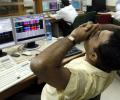
Indian equity investors experienced a significant loss of 16.32 lakh crore due to a two-day stock market decline fueled by escalating geopolitical tensions involving the US, Israel, and Iran.

The post-Covid euphoria surrounding direct equity investing has ebbed in 2025. Individual investors have turned net sellers in the domestic equity market, pulling out about 8,461 crore so far this year - a sharp reversal from the record purchases seen in 2024, according to a report by the National Stock Exchange of India (NSE).

Analysts predict that the ongoing conflict in West Asia, crude oil price fluctuations, and the US Federal Reserve's interest rate decision will significantly influence the Indian equity market this week.

The Indian stock market mythos of 36 years is wrapped in a diaphanous negligee, lashed together by a delicate, etheric sash of 1.6 bull markets. To make money from here on will require a ground invasion, trench by trench, rather than carpet bombing. Way more difficult, points out Shankar Sharma.

From the Sensex firms, Bharti Airtel, Power Grid, Tech Mahindra, Infosys, Bajaj Finance and Reliance Industries were among the major laggards. However, Larsen & Toubro, Bharat Electronics, UltraTech Cement and Maruti were among the gainers.

Indian benchmark equity indices Sensex and Nifty surged in early trade, driven by a sharp correction in crude oil prices below USD 100 per barrel and a rally in global markets, fuelled by improving sentiment surrounding US-Iran negotiations.
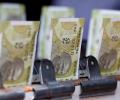
The Indian rupee rebounded 50 paise from its all-time closing low to settle at 96.36 against the US dollar, driven by retreating crude oil prices, signs of easing geopolitical friction, and likely central bank intervention.

The Indian rupee depreciated by 52 paise to settle at 93.35 against the US dollar, driven by failed US-Iran peace talks, surging crude oil prices due to a potential US blockade of Iranian ports, and a global flight to the greenback. This geopolitical uncertainty is also leading to foreign capital withdrawal from domestic equities.

Indian benchmark indices Sensex and Nifty climbed in early trade, driven by a significant drop in crude oil prices following reports of a potential 60-day ceasefire extension between the US and Iran, coupled with positive global market trends and buying in IT stocks.
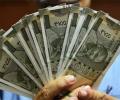
The rupee recovered to 95.18 against the US dollar after hitting an all-time intra-day low of 95.44. The recovery was supported by possible RBI intervention amid renewed Gulf tensions and rising crude oil prices.

'Investors shouldn't let fear dictate their decisions. The most important step is simply to begin investing.'

Indian stock markets are poised for volatility this week, driven primarily by the outcomes of five state assembly elections, ongoing high crude oil prices amid West Asia tensions, and the release of Q4 corporate earnings, according to market analysts.

Indian benchmark indices, Sensex and Nifty, closed sharply higher, with the Sensex climbing 1,695.40 points and the Nifty surging nearly 2 per cent, driven by a global market rally and a decline in crude oil prices following US President Donald Trump's declaration that his country has ended the war with Iran.

Indian equity benchmark indices Sensex and Nifty surged significantly in early trade, mirroring a global market rally and a drop in crude oil prices below USD 100 per barrel, driven by renewed hopes of diplomatic engagement between the US and Iran.

Indian equity benchmarks, Sensex and Nifty, ended lower after a spectacular rally, with the Sensex tumbling 931 points, as renewed tensions in West Asia, particularly the risk to the ceasefire deal after Iran closed the Strait of Hormuz, dampened investor optimism.

Benchmark indices Sensex and Nifty ended lower on Thursday, snapping a three-day rally, amid a weak trend in global stock markets.

Global financial institutions, including Goldman Sachs and Citigroup, have invested Rs 963 crore in One 97 Communications (Paytm's parent company) through open market transactions, acquiring a 1.34 per cent stake from SAIF Partners and Elevation Capital.

Among Sensex firms, ITC, Bharti Airtel, Trent, Bajaj Finserv, Titan and Reliance Industries were the major laggards. However, UltraTech Cement, Adani Ports, Tata Motors, Bharat Electronics, Bajaj Finance and Hindustan Unilever were among the major gainers.

Investors should do thorough due diligence when selecting a platform.

The Central Board of Direct Taxes (CBDT) has released a 198-page guidance note to assist crypto-asset service providers in complying with reporting obligations under the Income-tax Act, 2025, aligning India with the OECD's Crypto-Asset Reporting Framework (Carf) for automatic exchange of tax information.

From the 30-Sensex firms, NTPC, Trent, Bajaj Finance, Power Grid, Maruti, State Bank of India, ICICI Bank and Bharat Electronics were among the biggest gainers. In contrast, ITC, Kotak Mahindra Bank, Titan Company, Axis Bank and Bharti Airtel were the laggards.

'The real money in India over the coming period is likely to be made in small-cap stocks rather than in the large-cap benchmark names.'

Is the current rally telegraphing a durable peace plan in West Asia, boosted by United States (US) President Donald Trump's incoherent and contradictory posts on social media?
Indian benchmark stock indices, Sensex and Nifty, surged over 1 per cent, driven by optimism surrounding potential US-Iran peace talks and a significant drop in crude oil prices below the USD 100 per barrel mark. This de-escalation in geopolitical concerns and easing inflation pressures provided a substantial boost to investor sentiment.
From the Sensex firms, Bharti Airtel, Tata Motors, Mahindra & Mahindra, Kotak Mahindra Bank, Axis Bank and Reliance Industries were among the laggards. However, NTPC, Titan, Trent, ITC and Bajaj Finserv were the gainers.

Cleaner balance sheets, regulatory support and strong growth prospects helped Indian private banks attract over $6 billion in foreign capital, with more deals expected in 2026.

Amidst a sharp run-up in gold and silver prices, investors are advised to rebalance their portfolios by booking partial profits in precious metals and reallocating to domestic equities and debt, according to financial experts.

If we really want to curb the further depreciation of the rupee and make the rupee appreciate, we want to come out of the mindset that the exchange rate is merely a number, bring policy corrections to help reduce the outflow of foreign exchange by imposing suitable tariffs to discourage imports and bring self reliance, discipline FPIs, and correcting rules governing royalty outflows, suggests Dr Ashwani Mahajan, National Co-Convenor, Swadeshi Jagaran Manch.

Equity benchmark indices Sensex and Nifty rebounded sharply by nearly 1 per cent on Monday, driven by strong buying in power, banking, and financial stocks.

The remarkable rise of smallcaps reflects the emergence of a broad set of specialised businesses operating in industries where the sectoral tailwinds remain considerably stronger than macroeconomic headwinds, points out Debashis Basu.

Bajaj Finance, Bharat Electronics, Tata Steel, Tata Consultancy Services, NTPC, Trent, Asian Paints and Axis Bank were the major laggards among Sensex stocks. However, Tech Mahindra, ICICI Bank, Power Grid, Hindustan Unilever and Reliance Industries were among the gainers.

The Supreme Court of India has quashed criminal proceedings against Standard Chartered Bank and one of its officers in a 1991-92 Foreign Exchange Regulation Act (FERA) case, citing an extraordinary 23-year delay in prosecution and the Enforcement Directorate's failure to comply with mandatory procedural safeguards.

From the 30-Sensex firms, Eternal declined by 4.02 per cent, followed by Bajaj Finance (3.88 per cent), Sun Pharma, InterGlobe Aviation, Trent, Asian Paints, Mahindra & Mahindra and Bajaj Finserv. HDFC Bank emerged as the only gainer from the pack.
From the 30-Sensex firms, Tata Steel, Kotak Mahindra Bank, Reliance Industries, Axis Bank, Titan and Trent were among the biggest gainers. However, Tata Consultancy Services, Tech Mahindra, Infosys, Bajaj Finance and Sun Pharma, were the laggards.

The rupee appreciated 13 paise to close at 90.34 against the US dollar on Thursday, on trade deal optimism and overnight decline in commodity prices, even as the upside remained capped as investors look for more clarity on the India-US trade deal.
